SAN FRANCISCO MACYS’ SFSPCA HOLIDAY WINDOWS 2011

December 23, 2011

The magical attraction never fails.  O’Farrell at Stockton Streets, San Francisco.  Macys’.  Three days before Christmas.  Shoulder-to-shoulder crowds unknowingly magnetized toward the six SFSPCA windows. 

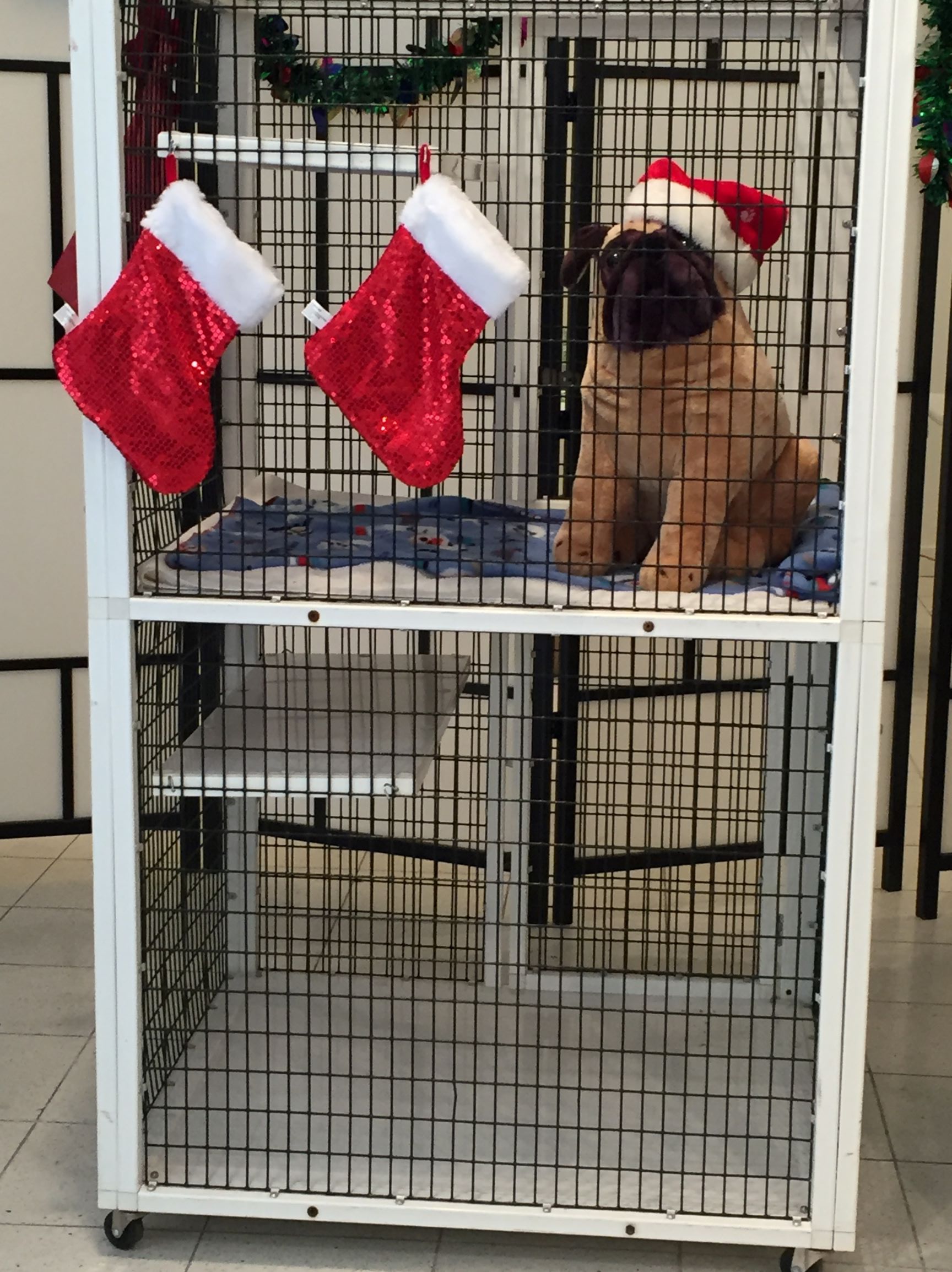
The 2011 windows are scaled down, simple, integrated with Macy’s promotional brands – just six windows, 5 for cats and 1 for dogs with a small adoption-count sign in the corner window.

The cat windows start on the Stockton Street side.   This one with golden eyes was a real crowd pleaser.

Or, how about the next window neighbor?

Wait a bit, and this one will move to another spot.

Move on to the next window where the action was way up high at the top of a cat tree, through a round window. 

Around the corner on O’Farrell Street, finally the dog window, one sleeping and one better visible.  Who knows what they are other than generally cute.  A little girl entranced. 

Empty window, “Pending Adoption” sign in place. 

A new occupant follows quickly.

The final, sixth window.

The signage was very discreet.

Numerous red-jacketed folk stood by, ready to assist potential adopters or collect donations in their boxes.

Tucked away on the first floor of the store was the real operations center.

The “stock room”!

Once again, it was a San Francisco Christmas – many cats and dogs in new homes when people have time to help them settle in.

NO PRETENSES 2011 ANIMAL LAW CONTINUING ED OFFERING @TORONTO ABA

August 7, 2011

The 2011 American Bar Association Annual Meeting is under way in Toronto, Canada, leaving the Tort, Trial and Insurance Practice (TIPS) Section’s Animal Law Committee to its own devices there.  ABA declined to pay for the usual conference call for ALC’s business meetings, and this year’s Continuing Legal Education offering, “2011AnnualMeetingAnimalLaw” offers no pretense of balance this year.  Sorry to miss it for the opportunity to see in person who is advocating what.  Last year’s ALC CLE program in San Francisco drew only about 18 attendees, while many others in the jam-packed days of CLE offererings featured well-known panelists and nearly full rooms at the cavernous Moscone West convention facility, perhaps metaphoric for the spectrum of irony and dichotomy of “animal law” as a legal practice area.

SAN MATEO COUNTY ANIMAL NEWS, 2011

July 10, 2011

Front view - PHS&SPCA's nearing completion, new Center for Compassion.

San Mateo County (CA) has extended its animal control contract with Peninsula Humane Society for another 4 years, to June 30, 2015. PHS&SPCA is nearing completion of its new “Tom and Annette Lantos Center for Compassion” at 1450 Rollins Road, Burlingame where it prevailed in the contentious city land use process. The nonprofit programs will be located in Burlingame while the animal control program (lost holds, surrenders, s/n clinic; licensing and microchip at both locations) continues at leased county location, 12 Airport, San Mateo.

Rear view, massive new Center for Compassion, opening September 2011

Our blog post SAN MATEO COUNTY FREE SPAY/NEUTER VOUCHERS, August 12, 2007 is still a popular search hit, and we’re pleased to note that this County administered program is still alive and well and offers its information pamphlet in English, Spanish and Chinese. The County licensing information is only offered in English and finally in Chinese.

It takes some knowledge of several languages to get through the day in much of San Mateo County. Someday, PHS&SPCA might want to publicly acknowledge reality of diversity here as it moves forward with its ambitious mission and programs to ensure that these truly do benefit the entire community.

PET STORE ADOPTIONS, FOURTH OF JULY WEEKEND 2011 — THE ADOPTIONEERS

July 3, 2011


On a warm Saturday afternoon, back to San Mateo Pet Club, I-92@I-101 for another large bag of puppy food. The “adoption” van was out front with 4 stacked up, empty wire crates inside. Sure enough, the other 9 crates were lined up in the store with the human crew lunching at one of their card tables; white man and woman, T-shirts, “Rescued is my favorite breed”. The dogs were mostly napping. The adoptioneers seemed busy among themselves.

http://www.dogsneedhomes.blogspot.com/

Across the store was Homeless Cat Network, a long established local (c)(3) with a crew of volunteers and a bank of 8 cages.

http://www.homelesscatnetwork.com/


PET STORE ADOPTIONS – 2011 STYLE

June 19, 2011


A June Saturday mid-day, quick stop at the San Mateo, California Pet Club* store, the first location south of San Francisco with a decent inventory of puppy foods and fortunately, without the now six month old puppy along on this day. Get a cart and navigate the angles into the store…a lot of yipping for just customers’ dogs. A few dog crates and a card table… is it a training class?

A closer look reveals a total of 13 crates, 11 dogs. A seventy-ish white lady customer asks the woman near the table if this is “Poodle Rescue?” “No, these dogs were taken out of shelters in Southern California and were strays with no identification.” replies the archetypical rescue lady, going on to say she had two of these at home for herself, and they bantered on that some people should never have dogs.

What’s the deal? The sign says $400. Lots of dogs to choose from.
Who got this many dogs and all their crates to the store? In the parking lot was a late model long cargo van with identifying license plate and the “rescue lady’s” own compact SUV. Who keeps all these dogs where when they’re not at the store? These are not dogs from San Mateo County, where Peninsula HS&SPCA has been able to successfully place all of our own plus some outside intake for many years, nor are these from local rescue groups or adjacent counties. A handwritten note on one crate did say “single pet home, not good with children” but is this outreach adoption such as we’ve seen done by local shelters and rescues or is it something else?

* Pet Club in the San Francisco Bay Area is a local chain, non-membership — cash, ATM or checks only with a good inventory of practical products and dog foods including puppy foods. The “big box” pet stores carry almost no puppy foods, what they do stock is priced double, and dog food inventory is heavy on “overweight”, “geriatric”, skin and other allergies, and more treats than worth sorting out. Pet Club actually has a step on scale for customers’ dogs and does not sell dogs itself.

GOLDEN GATE KENNEL CLUB DOG SHOW, NOT JUST AN EVENT BUT AN ENDURING OCCASION

February 6, 2011

The Golden Gate Kennel Club dog show, one of the last remaining benched AKC shows has come and gone again, something like a major holiday for participants. We approach it with both anticipation and dread, memories of dogs and people past, either gone from this life or no longer able to come. Inevitably a few humans will be irritating while others rise to and above the occasion as we navigate the public gate walking the aisles with snack-dangling children, taking care of ourselves and dogs, almost forgetting there is still a dog show. Despite the sometimes claustrophobic, cramped conditions, this annual occasion — not just an event — has been a unique cultural fabric connecting people and dogs into a metaphoric banner stretching over decades. The increasingly multi-cultural gate, reflecting the changed demographics in the San Francisco bay area is both challenge and opportunity to the dog fancy to recognize the interest in dogs is universal.

Twenty years ago when the sting of prohibitive legislation was fresh, the GGKC entries twice the numbers now and gate jostling shoulder to shoulder throughout the cavernous spaces, we had a table in the “South Hall” loaded with clipboards holding petitions against the “San Mateo Pet Overpopulation Ordinance” that cast as much dread over the occasion as impending foreclosure on the family homestead. That we are still here is due to that universality of dog breeds as varied cultural expression that has endured direct and indirect challenges throughout history. A fact lost on the self-righteous folk who decided this year to make our occasion into their picketing opportunity, crowding across the public entrances on both Saturday and Sunday. However, the public did engage them in arguments or ignore them. Despite the agressive signs, their flyers — other than their message — merely had the contact information for local animal shelters and mainstream rescue organizations.

Meanwhile, the show did go on. The Dalmatian Club of Northern California won the best decorated bench award with their Facebook theme, which may portend more for how we go on than how we decorate.

SAN FRANCISCO MACYS’ SFSPCA HOLIDAY WINDOWS 2010

December 6, 2010

In December 2009, we noted the Macys’ San Francisco holiday pet adoption windows, the annual project of the San Francisco SPCA, seemed a little scaled-down compared to 2008, but this year’s windows are positively austere  at the prime corner of Stockton & O’Farrell Streets just off Union Square.  The corner window, Stockton side decorative scene features stylized figures — 2 humans, a blond female and black male (neither particularly representative of today’s San Francisco), 2 dogs — a sort-of Dalmatian and an unmistakeable Dachshund and an orange cat. 

The other side of the corner window has human figures caroling but no animals.

The most interesting feature was the catwalk with a human teaser toy  trying to entice a cat to walk up to a high spot with an outside window view.

On the “ground” level, were more kitties.

Another kitty waiting for more action:

Finally, the dogs!  These two had been “adopted”. 

Mission accomplished, we headed up the block to Union Square for a little stronger dose of holiday spirit and actually saw a dog.

And moved northward for more perspective:

Union Square 2010

LABOR DAY, 2010: SPECIAL REPORT

September 8, 2010

Editor’s Note:  Originally published September 6, 2010 by The Animal Council Updates as a single topic, timely piece. 

LABOR DAY, 2010: SPECIAL REPORT

Labor Day 2010 is the first in a long while no U.S. flag is flying here.  There is no place to display one properly after months of construction work.  Today the “tile guys” are outside working, because they have had so little work this year, they need to work every day they can.  Their Labor Day picnic will be a quick lunch in the shade on our lawn, yet as meaningful as the traditional celebrations around the country today with glad-handing politicians and union folk.  While we pause to acknowledge the role and status of labor, we step back from the unmistakable rhetoric and actions of anger, ignorance and intolerance now creeping into American public life. 

As an interest group, we know our own frustration confronting political opponents who know little or nothing about animals or us, yet disrespect us as a group and sometimes individually, with regard for nothing or no one other than their views of what people should not do with animals.  Their ugly words and actions hurt, and the indifference of others hurts us, too.  So, shouldn’t we know or be able to learn not to mimic this negative behavior ourselves? 

Here’s the problem.  As more of our own people participate in online activism, searching for interesting animal information, hit the “Forward” button without reflection on whether the item is truly relevant, appropriate or capable of explanation, readers pound their own “Forward” buttons or, worse add hasty comments to the flow.  We all try to sort the useful information and discard the rest, whether irrelevant, incorrect, redundant or tasteless — this goes with the online world.  But, we now find increasing numbers of posts mentioning Islam — pertaining to animals in Islamic countries or even beyond to other issues, with no consideration as to whether or how these are relevant to our common interest in preserving animal ownership and interests or whether this serves our understanding of these issues and ability to work effectively among ourselves.  In our opinion, this practice undermines these concerns and must stop or be stopped.  Here’s why.

When Madeleine Albright became US Secretary of State in the Clinton administration, she wrote on her to do list, “Lean more about Islam”.  She was already well-educated with a long career in public service.  While we won’t need the cultural literacy in an unfamiliar religion, followed by now over a billion and a half people, to conduct diplomacy credibly, we should know enough to understand that random news reports about fatwas of Shiite clerics and Wahhabi edicts regarding animals are not even about animals.  These are different from say, the Jordan government’s efforts to regulate pet store sales of puppies imported from eastern Europe — a familiar, relevant topic here, where the predictable consequence was “puppy mills” in the northern desert. 

Listen to any news today and hear Americans who should know better spew slanderous, uninformed rants about Islam that demean our own country’s values.  We cannot let this insidiously seep into our own dialogues on animal issues.  Those who are serious about commenting on the treatment and regulation of animals in contemporary Islamic societies, should be able to distinguish the various sectarian contexts from legitimate government regulation and explain whether and how a specific situation truly involves animals or would have any relevance to modernity or western culture. 

This past May, the gorgeous, articulate Ayaan Hirsi Ali, the Somali born woman known world-wide for defending the rights of women in Dutch Muslim society, was here in San Francisco (with her American bodyguards), decrying the lack of critical thinking and criticism within Islam and urging criticism from the West in the same way the behavior of abusive Catholic clergy is criticized without condemning Catholicism or even Christianity.  Those who do not know the difference between abusive excesses and an underlying religion — whatever religion — do us all harm when they hit “Forward” and “Send”.  Too many of our own people are succumbing to this temptation for private reproaches. Rather, we ask everyone to recognize and resist this urge, especially those representing an organization or list owners who can put a stop to it.  We know the pain of ignorant attacks; let us not be the perpetrators. 

To follow Madeleine Albright’s to-do item, we suggest a totally painless, non-sectarian historical book, “Destiny Disrupted, A History of the World Through Islamic Eyes” by San Francisco author and Afghan-American, Tamim Ansary.*  Tamim was an English major at Reed College and has had a career as a textbook editor, inadvertently becoming a spokesperson for Afghanistan and related issues 9 years ago. 

available from http://www.amazon.com
Also see http://www.mirtamimansary.com


ANIMAL WORD WARP: Introduction – Twisting Familiar Words to Different Different Meanings, Meaningful or Not

January 10, 2010

 ANIMAL WORD WARP is a publication of The Animal Council, published serially exclusively on our Blog, exploring divergent usage of words relating to animals by English speaking Americans as we start the second decade of the twenty first century.  The divergences interesting to us are not merely synonyms but shift meanings, whether or not intented, either actively or passively.  Are these divergences meaningful and why?  Can they be contrived to change public policy, hearts or minds?  Do we use words with intention or mere familiarity and habit? 

The meaning of “warp” of interest to us is to distort, twist or turn from one sense to another, ranging from inperceptible to radical.  When must we be mindful of our own usage, and when might we challenge others’ usage?  Are some divergences merely innocent and perhaps unintentional or negligent but others sinister and divisive? 

In this field, most people now realize that “owner”, “guardian”, “pet parent” and even generic words like “caretaker”, “custodian” or “keeper” can be tricky, politicized words, but what about terms like veterinary “elective” versus “cosmetic” procedures or “breed specific” versus “breed profiling”?  What about the nebulous euphemism, “automatic right of entry” versus deprivation of 4th amendment search warrant requirement?  These are some of the terms we’ll discuss in this series, but we begin with a simpler example.

Last month, four dog clubs held American Kennel Club licensed shows at a facility currently called the “San Mateo Event Center” now on the signage and print media.  The immediately prior name, “San Mateo Expo” is printed on the parking receipts.  On the first show day, the announcer’s voice over the loud-speaker said, “The Fairgrounds called…”  In most of our minds, this facility has and always will be the “fairgrounds” where we went for the County Fair, dog and cat shows and until recently, dog training.  The facility still falls under authority of the state agricultural law covering what we know as “fairgrounds”, albeit often under political pressure for sale and redevelopment for housing and commercial use.  The famed Bay Meadows race track with its sprawling stables used to be next door, is now one final pile of rubble.  At the “Event Center”, buildings where we used to train dogs have been turned into a satellite wagering facility (see final photo below).  San Mateo Dog Training Club held its last classes there a couple years ago and is just now starting classes at a small facility in another town.  The actual local AKC all breed club has been holding its show 50 miles away, far from San Mateo County.  But, the “Event Center” must need some rental income after Christmas, so for now, we can still visit “the fairgrounds” for these shows.  As showgoers know, the sight of vendors’ peaked tents means we’re almost there.  Hurrying in with dog(s) and equipment in tow, it would have been easy to miss the “No Dogs Allowed” signs, an ominous juxtaposition and a “first” for the California fairgrounds we visit. 

© The Animal Council and The Animal Council’s Blog, 2010.

San Francisco Macy’s SFSPCA Holiday Adoption Windows 2009

December 22, 2009

The now traditional San Francisco SPCA windows at Macy’s seemed a little scaled down and unfocused this year, and the rest of the windows at the prime Stockton & O’Farrell corner by contrast were devoid of any visual interest.  The 3 fabulous, cropped Harleqin Great Dane mannequins  from last year (see December 2008 entry and photo) were nowhere to be seen, but purebred models still ruled with the lone  Harleqin,  a Chinese Shar Pei and the fawn Dane with natural ears gracing the corner window.   The Monday afternoon we were there, the only live animals on display were a few cats.   As always, we applaud holiday season pet adoptions.

O’Farrell Street Harlequin

Stockton Street Fawn:

And the Chinese Shar Pei!


Follow

Get every new post delivered to your Inbox.